ESIGN & UETA · built and run by DBX Enterprises

Signatures that carry their own evidence.

DBX Sign sends documents for signature and keeps the proof that they were signed — a hash-chained audit trail, a sealed PDF, and a page anyone can use to check a document was not altered. Built for real-estate transactions, where several people see different parts of the same deal.

No account needed to sign, and none to check a document is genuine.
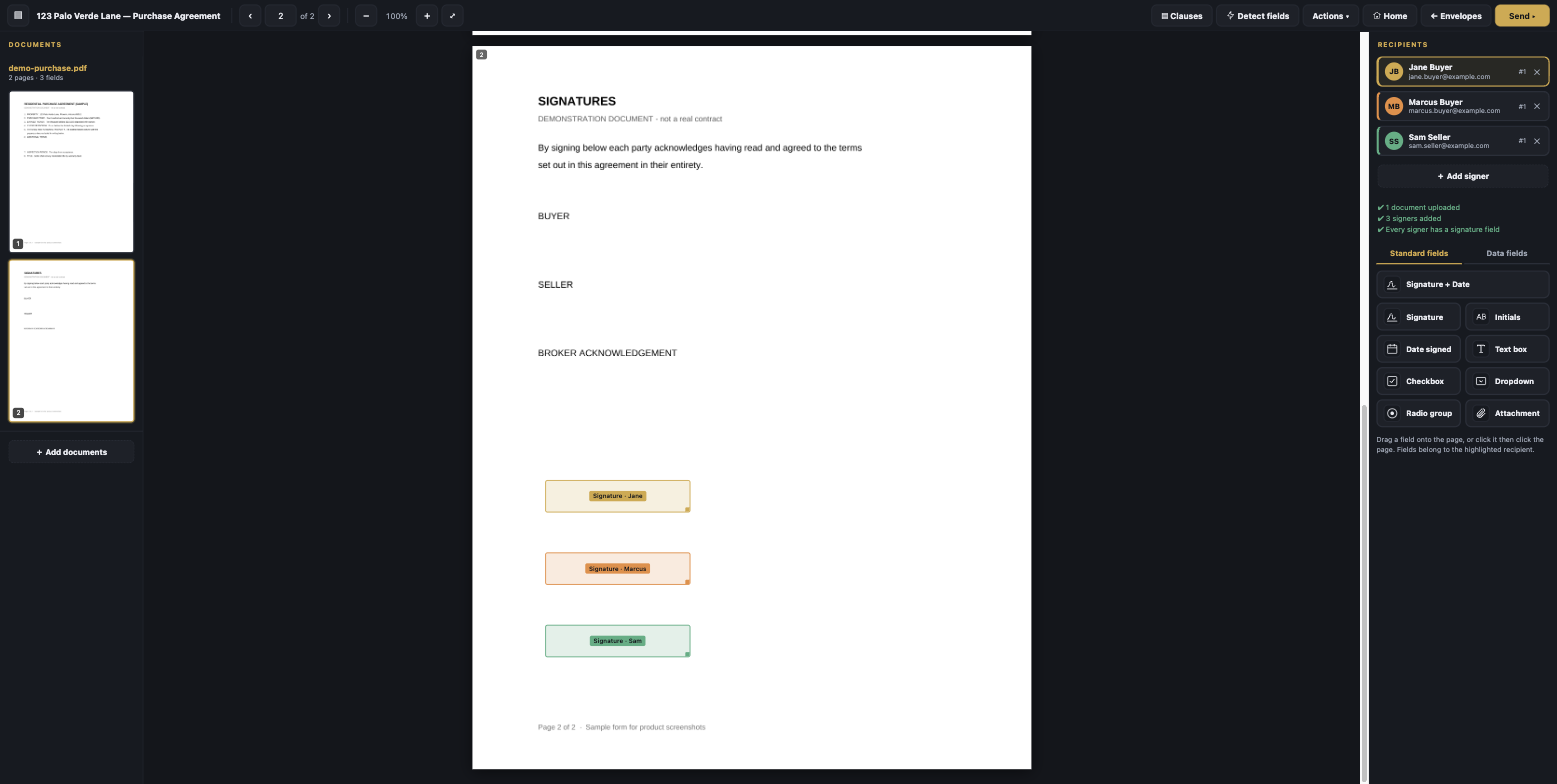
sign.dbx-ai.com — preparing a purchase agreement
The DBX Sign workspace: a purchase agreement open on page two with three colour-coded signature fields placed for the buyer, co-buyer and seller, the recipients listed down the right, and a readiness checklist confirming every signer has a signature field.
How it works

Upload, say who signs where, send.

The parts people actually repeat are the parts that are made quick — the people you send to, the wording you reuse, and the packets you send again and again.

Any document

PDF or Word, converted on upload. Place signature, initial, date, text, checkbox and dropdown fields exactly where they belong — or type your own wording straight onto the page before it goes out.

The people, remembered

Anyone you send to is kept in your own address book, searchable next time. Sign in turn or all at once. A viewer is simply copied in; a signer must be given somewhere to sign, and the send tells you if they have not been.

Packets, not paperwork

Save a packet once — the documents, the parts it is written for, and where each part signs. Mark a part optional and the same template serves one person or three. Keep the wording you reuse in a clause library and drop it in anywhere.

For a real-estate deal

One vault. Everyone sees their own part of it.

A transaction holds every document and every envelope that belongs to one deal, with its parties, its versions and its timeline in one place. Each side sees what they are entitled to see — and nothing else.

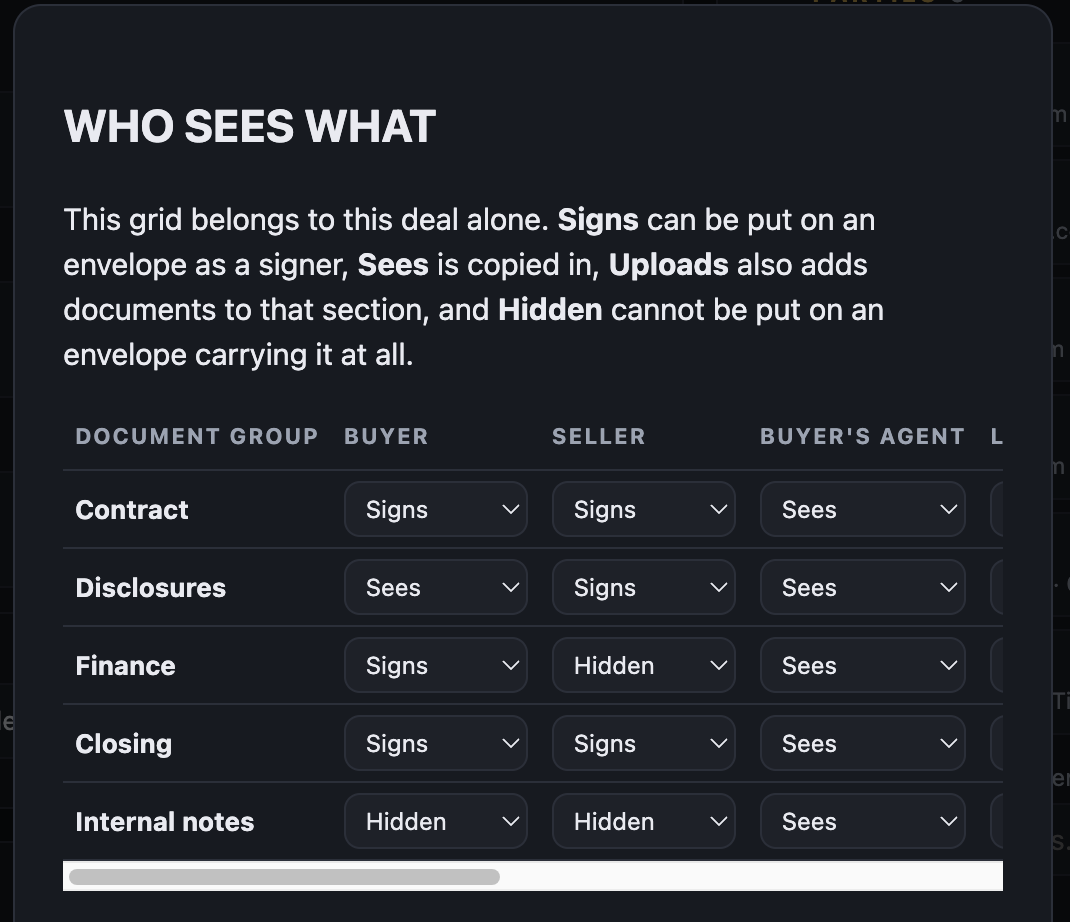
  • Who sees what, per deal. Every role either signs, sees, uploads to, or is hidden from each section. It governs sending, not just the screen.
  • Originate from the deal. Raise an envelope and the documents and people are already on it.
  • Versions kept. Replace a document and the old one stays in the record; one already sent out cannot be removed.
  • A second owner when you need one. Make a party an editor and they can upload for the whole deal and bring in their own coordinator.
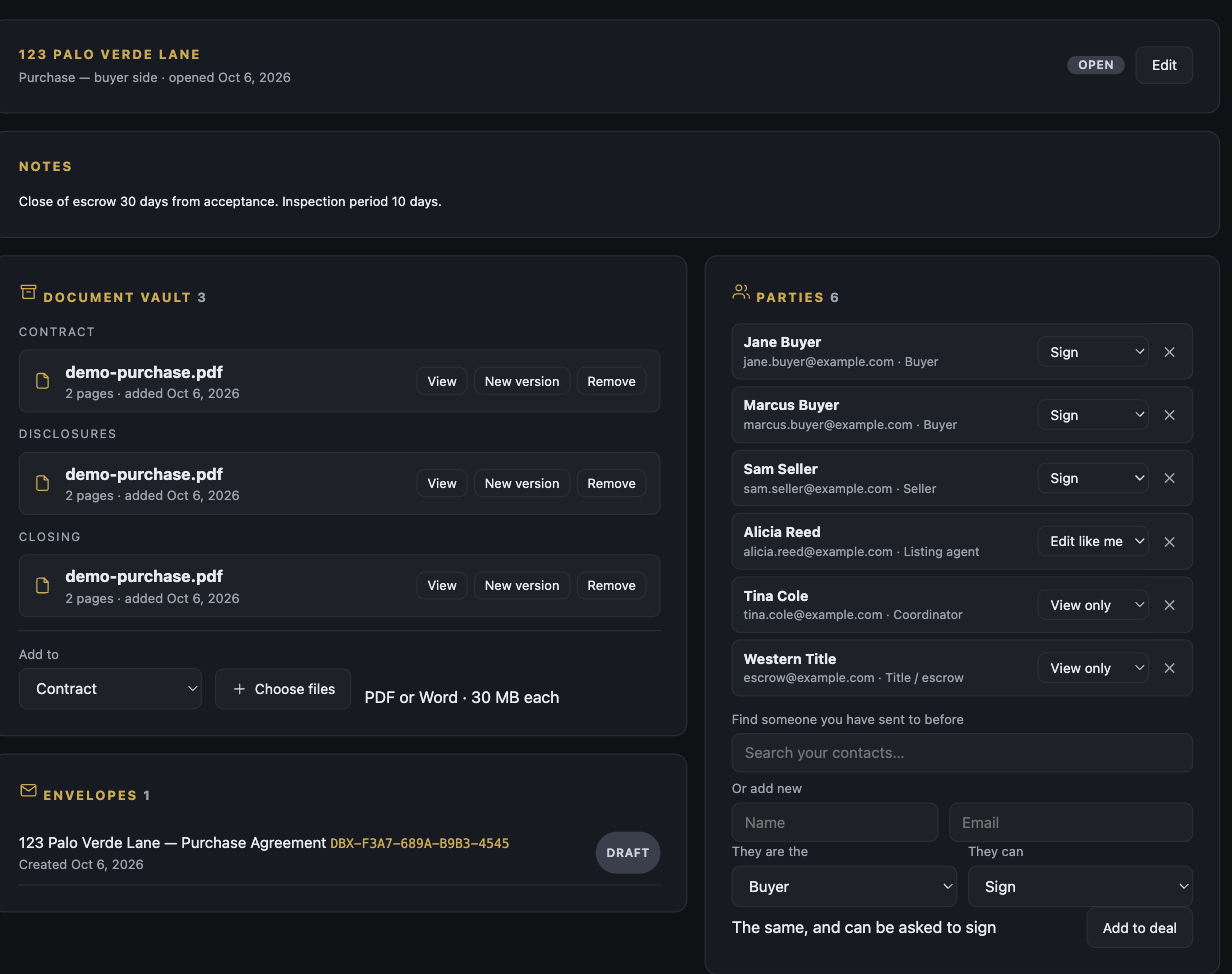
a deal — vault, parties, envelopes, timeline
A transaction in DBX Sign for 123 Palo Verde Lane, showing the document vault grouped into contract, disclosures and closing, and the six parties on the deal each with their role and whether they sign, view only, or edit.
Control

The grid decides, not the good intentions of whoever is sending.

A lender hidden from the seller's disclosures cannot be put on an envelope carrying them — the send is refused and says which person and which section. Each deal keeps its own grid, so changing one deal never changes another.

  • A ladder that matches a brokerage. Company Admin, Broker, Designated Broker, Agent, Transaction Coordinator, Assistant. Each seat adds only the seats below it.
  • Everyone is a silo. You see your own work and everything beneath you in the line. People side by side never see each other's.
  • Licences on the record. Every action is recorded against the licence it was performed under, and that licence is inside the tamper-evident chain.
who sees what
The who-sees-what grid: five document groups down the side — contract, disclosures, finance, closing and internal notes — and each party role across the top, with each cell set to signs, sees, uploads or hidden.
The evidence

Every envelope can prove its own history.

An electronic signature is only worth the record behind it. DBX Sign writes that record as it goes, and anyone — with no account at all — can check a finished document against it.

verify → audit_chain_intact: true  ·  sealed_file_intact: true  ·  sha256: 9f2c4ab1e07d53c8… — what the public verification page returns for a document that has not been touched.

Anyone can check it

Drop a sealed PDF onto the verification page and it will say whether it is genuine and unaltered. No account, no login, no charge.

Recipients keep their copies

Anyone who has been sent something can ask for a link to everything they have ever received, and download it — individually or all at once. The link expires and can be revoked, and they never need an account.

Backed up, and the restore is practised

Deduplicated nightly snapshots with an independent offsite copy, and a restore drill that is run rather than assumed.

Honest about what this is

Compliant, and careful about saying more than that.

DBX Sign executes signatures in accordance with the federal ESIGN Act and UETA as adopted by the states, including Arizona, and carries the evidentiary attributes eIDAS describes for advanced electronic signatures.

We do not describe DBX Sign as certified, accredited or audited, because it is none of those things. Where a claim would need a third party to stand behind it, we do not make the claim. The legal page sets out exactly what is and is not true, in detail.

  • No third-party signature vendor sits in the path of your documents. DBX Sign is operated by DBX Enterprises on its own infrastructure.
  • Documents live in an encrypted vault on the server, not in a general-purpose bucket.
  • Association and state forms are not shipped with DBX Sign, because they are licensed by the bodies that own them. The form library enforces the conditions a publisher sets for the forms you are licensed to carry.

Put a document in front of someone today.

Sign in to start, or check a document you have already been sent.